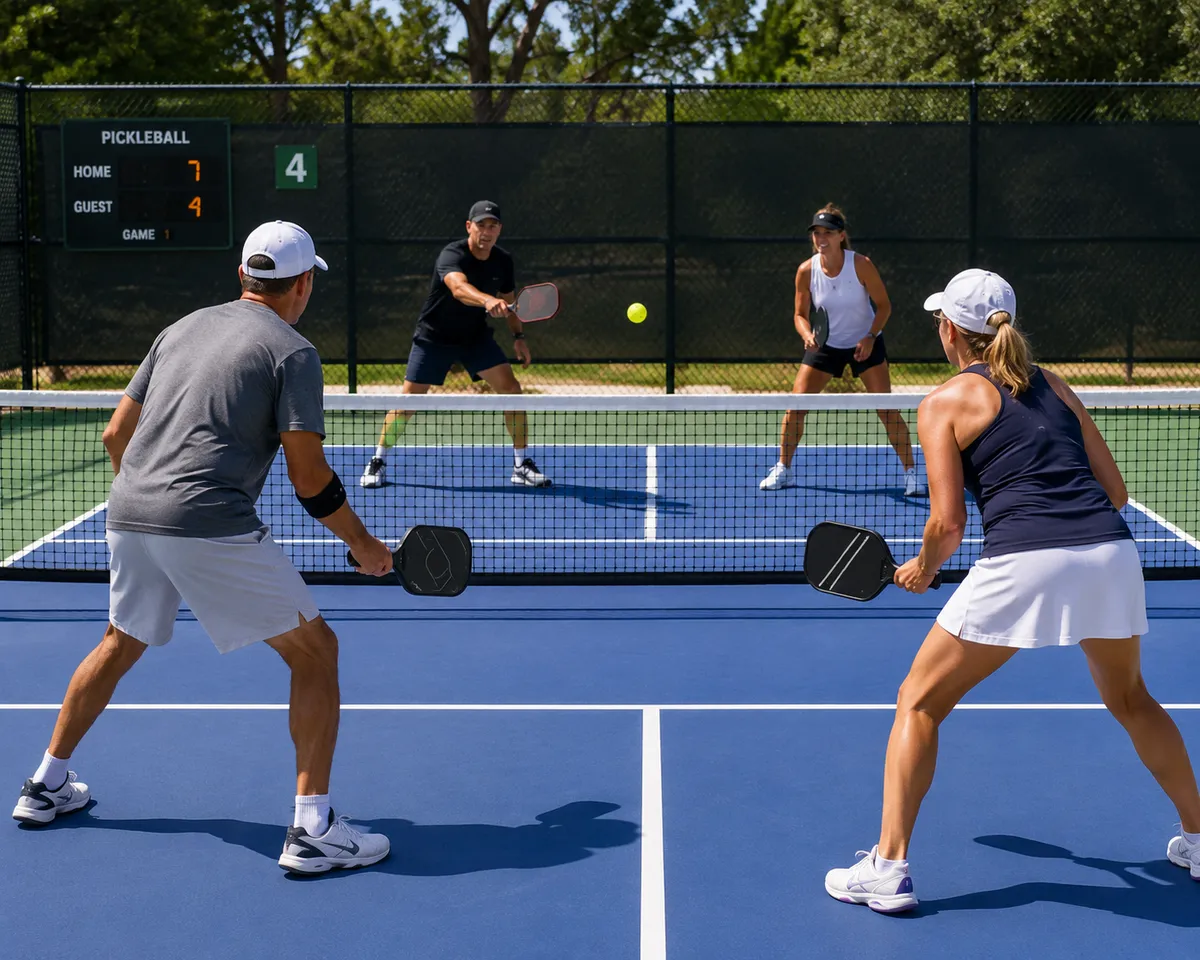
Pickleball rules doubles: A complete guide to serving, scoring, and winning points
Key Takeaways
Doubles pickleball becomes much easier once you know where to stand, who serves, and when you may volley. Use these five points as a quick court-side refresher.
Serve diagonally, underhand, and from behind the baseline.
Let the return and the serving team’s next shot bounce.
In traditional scoring, only the serving team can score.
Stay out of the kitchen when volleying.
Communicate with your partner before fast exchanges become confusing.
How doubles pickleball is set up
A doubles game uses the same court as singles, but four players share its space and must coordinate their movement. You need to recognize the baseline, sidelines, centerline, and non-volley zone before the first serve. If you are still learning the layout, this essential rules summary gives you a quick companion reference. Once the lines make sense, positioning and serving calls become far less intimidating.
Court dimensions and boundary lines
A pickleball court is 20 feet wide and 44 feet long, including the doubles playing area. The net divides the court, while the baseline runs parallel to it at the back of each side. A centerline separates the service courts, and the sidelines mark the outer edges.
The non-volley line sits 7 feet from the net on each side. In doubles, the ball is out if it lands beyond a sideline or baseline, but a ball touching a line is generally in unless it touches a line that defines a non-volley zone during a serve.
The non-volley zone and kitchen
The non-volley zone, commonly called the kitchen, extends 7 feet back from the net on both sides. You may enter it to play a ball after it bounces, but you cannot volley while standing in the zone or touching its line.
Momentum matters too. If you volley outside the kitchen and your follow-through carries you into it, that is a fault. You can step into the area after the ball bounces, so think of the kitchen as a restriction on volleys rather than a forbidden part of the court.
Player positions and starting formation
At the start of a traditional doubles game, the serving team begins with one server on the right-hand service court. The receiver stands diagonally opposite, while the other two players can begin wherever their team chooses on their side, provided they do not create an illegal service position.
The server’s partner commonly starts near the non-volley line, but that is a tactical choice rather than a universal requirement. The receiving partner often stays near the kitchen line as well. Before serving, confirm which player is receiving and which service court is correct.
Equipment and ball requirements
You play with a solid paddle and a perforated plastic ball designed for pickleball. Indoor and outdoor balls can feel different because their hole patterns and materials affect speed, bounce, and wind response. Use equipment accepted by your local league or tournament when formal standards apply.
For a current technical reference, the official rules guide is the better place to check equipment standards and annual rule changes. Recreational players can usually focus first on a serviceable paddle, an appropriate ball, and a court with clearly visible lines.
How serving works in doubles
Serving is the most structured part of doubles pickleball, and small position errors can change the outcome of a rally. You serve from behind the baseline to the diagonally opposite service court. The serve must clear the kitchen and land in the correct box, so take a moment to identify the target before you start your motion.
The correct serving side and court
The first server begins on the right side and serves diagonally across the net. If the serving team wins the rally, that same player serves again from the opposite side. The server continues alternating sides after each point won by the serving team.
When the first server loses a rally, the second partner serves. After that server faults, the opposing team receives the serve, with the traditional exception that the starting team begins with one service opportunity before the serve changes sides. Calling the score before the motion helps everyone track this sequence.
Underhand technique and legal contact
The serve is made with an underhand motion. At contact, the paddle must move upward, and the ball must be struck below the waist under the standard volley serve requirements. Your feet must remain behind the baseline and within the correct extension of the service area until contact.
A legal serve does not need to be fast. A controlled motion that sends the ball high enough to clear the net and deep enough to pressure the receiver is often more useful for a developing player than a risky hard swing. A drop serve may also be permitted under the rules being used, but confirm the local or tournament standard first.
Diagonal serves and landing requirements
The ball must travel diagonally and land in the opponent’s service court. It cannot land in the kitchen or touch the non-volley-zone line on the serve. A serve that clips the net and still lands legally is normally played, while a serve that does not reach the correct court is a fault.
Your target should leave a comfortable margin from every line. Aiming directly at a corner may look aggressive, but a small error gives away the rally immediately. Start with depth and consistency, then add placement as your control improves.
Service faults and replay situations
A service fault occurs when you serve from the wrong position, strike the ball illegally, miss the intended diagonal court, or land the ball in the kitchen or beyond the service boundaries. In most ordinary situations, the fault ends the serving team’s opportunity rather than creating a replay.
A let or replay can depend on the rules in force and the circumstances of the interruption. If a stray ball enters the court, a player is distracted by outside activity, or an official stops play, pause instead of guessing. Agree on the ruling before the next serve.
How scoring and rotation work
Most recreational doubles games use traditional side-out scoring, meaning only the serving team earns points. A team usually plays to 11 and must win by two, although local games may use another target. The score is not decoration: it tells you the serving team, server, and service court.
Rally scoring versus traditional scoring
Under traditional scoring, the serving team can win a point, while the receiving team can win the rally and gain the serve without adding a point. Some leagues use rally scoring, where every rally produces a point for one side. You should agree on the system before play begins because the rotation and end-of-game expectations can differ.
The standard doubles score is spoken as three numbers: the serving team’s score, the receiving team’s score, and the server number. At the start of a game, the opening team is often announced with a third number of two to reflect the initial one-server exception.
Calling the score before each serve
The server calls the complete score loudly before serving. This gives both teams a chance to catch a wrong server, wrong side, or mistaken point total before the ball is in play. If you hear an error, stop the sequence promptly and resolve it calmly.
Here is the basic meaning of each part of the call:
Score elementWhat it identifiesWhy it mattersFirst numberServing team’s scoreShows whether the serving side has earned pointsSecond numberReceiving team’s scoreKeeps the game total alignedThird numberServer numberShows which partner is servingStarting exceptionOpening server statusExplains why the first team may have one server
The call is a practical reset, not a performance. Use it every time, especially when a long rally, side change, or close line call has made the rotation hard to remember.
How teams switch sides
Teams switch sides when the serving team reaches the agreed midpoint in a game, such as when one side reaches 6 in an 11-point game. Players keep their relative service positions while moving to the opposite end of the court. The switch helps balance wind, sun, and other court conditions.
If you are playing casually, announce the switch rather than assuming everyone noticed. A short pause prevents the common mistake of serving to the wrong diagonal court after changing ends.
When partners change serving positions
Within a team, the server changes sides after winning a rally and earning a point. The partner does not automatically become the server; instead, that partner serves when the current server loses the opportunity and the team still has its second server.
This means your partner’s location can help you remember the rotation. If you are serving from the right, your partner should occupy the corresponding opposite service position for your team’s formation. Keep the pattern consistent instead of chasing the ball and forgetting the next court.
Understanding the two-bounce rule
The two-bounce rule shapes the opening of every doubles rally. The receiving team must let the serve bounce, and the serving team must let the return bounce before either side may volley. This slows the first exchange enough to prevent the serving team from rushing straight to the net.

The return of serve must bounce
The receiver cannot volley the serve out of the air. The ball must bounce once on the receiving side before it is returned. You may move behind the ball and hit it after the bounce, but contacting it before that bounce loses the rally.
A deep serve often pushes the receiver backward, making this required bounce more demanding. Let the ball travel when necessary, set your feet, and return it with enough height and depth to give your team time to recover.
The serving team’s third shot
After the serve bounces and the return bounces, the serving team must also play its next shot after a bounce. This is commonly called the third shot, although the exact count can vary in casual conversation depending on how players describe the sequence.
You can drive the third shot firmly or use a softer drop that lands near the kitchen. The choice depends on your position, the height of the returning ball, and how much time your team has to move forward. A safe shot that lets you approach is often more valuable than a low-percentage winner.
When volleys become legal
Once the serve and return have each bounced and the serving team has played its bounced shot, both teams may volley, provided they obey the kitchen restrictions. A volley is a shot taken before the ball touches the ground. You can volley from behind the non-volley line, but your feet and momentum must remain legal.
Near the kitchen, keep your paddle ready in front of your body and avoid reaching so far that your balance carries you forward. Your feet matter as much as your paddle when you are deciding whether an aggressive volley is legal.
Common two-bounce rule mistakes
Beginners often rush the return, especially when the serve arrives slowly and seems easy to attack. Another mistake is to let the return bounce but volley the next ball before the serving team has completed its required bounce. These errors usually come from reacting to the ball instead of tracking the sequence.
A simple mental count helps: serve bounce, return bounce, serving team’s bounced shot. After that, volleys are available unless the kitchen rule prevents them. Practice the pattern at half speed until it becomes automatic.
Faults that end a rally
A fault ends the rally and awards the result according to the scoring system in use. Some faults are obvious, such as a ball landing outside the lines; others happen because a player forgets the kitchen or two-bounce rule. Knowing the categories lets you correct the real problem instead of blaming a missed shot.
Hitting the ball out of bounds
A ball is out when it lands beyond the applicable boundary line. A ball touching a sideline or baseline is generally in, so wait until you can judge where it lands rather than calling it out in the air. The non-volley-zone line has special significance on a serve because a serve touching it is not legal.
When you are unsure, make your call promptly and honestly. In recreational play, the team closest to the line usually has the best view, but both sides should respect the call and replay only when the agreed rules allow it.
Serving into the kitchen or wrong court
A serve that lands in the kitchen, touches the kitchen line, or lands in the wrong diagonal service court is a fault. Serving from the wrong side or with the wrong server can also create a position fault. These are preventable errors if you identify the target and announce the score before serving.
Aim several inches inside the lines while you build consistency. Once your serve is reliable, you can work on directing it toward a receiver’s weaker side without sacrificing legal placement.
Stepping into the non-volley zone
You fault if you volley while touching the kitchen or its line. You also fault if your momentum after a volley carries you into the zone. The restriction applies even when the ball itself is headed safely over the net.
You may enter the kitchen to play a ball after it bounces. Let your body settle before attempting the next volley, and use a small recovery step backward rather than jumping forward into the line.
Contacting the net or interfering with play
Touching the net, its posts, or the supporting structure during the rally can be a fault, depending on what was contacted and when. Reaching over the net before the ball crosses to your side is also generally illegal unless the ball has already bounced on your side and its spin carries it back.
Interference matters too. Calling out loudly, crossing into the opponent’s space, or moving in a way that distracts an opponent may affect the rally. When an outside object or person disrupts play, stop and agree whether the point should be replayed.
Doubles strategy within the rules
Good doubles strategy is less about hitting every ball hard and more about making legal shots that keep both partners connected. You want to protect the middle, reach the kitchen line together, and force opponents to hit from uncomfortable positions. The rules create the boundaries, but teamwork determines how well you use the space inside them.
Moving together as a team
Move forward and backward as a pair whenever possible. If one partner reaches the kitchen while the other stays near the baseline, the open space between you becomes an easy target. Shuffle rather than crossing your feet, and adjust your position as the ball moves from side to side.
The player without the ball should watch the opponents and cover the middle. That supporting role is active, not passive. Stay ready for a deflection, an attack at your partner’s feet, or a ball redirected into the open court.
Choosing between a drive and a drop
A drive is useful when the ball is high enough to attack and you can keep it low. A drop is useful when you need time to move forward or when a hard shot would likely be returned aggressively. Neither option is automatically the “right” third shot.
Choose based on your balance, the opponent’s position, and the height of the ball. If your team is still moving up from the baseline, a controlled drop can buy time. If the return sits high, a firm drive may create a weaker reply.
Communicating during fast exchanges
Use short words such as “mine,” “yours,” or “bounce” before the ball reaches the decision point. Decide in advance who takes the middle when both players could reach it. Clear communication reduces hesitation, which is often more damaging than a slightly imperfect stroke.
A quick list can help you build a simple doubles communication routine:
Call the ball early and use your partner’s name when helpful.
Say “switch” only when you clearly intend to change sides.
Warn your partner when an opponent is moving behind the ball.
Reset quietly after an error instead of assigning blame.
These habits keep your attention on the next shot. They also make recreational games more enjoyable because everyone understands what happened without turning every point into an argument.
Handling disputed calls and line balls
Make line calls from your side of the court, and give the opponent the benefit of the doubt when you did not see the landing clearly. A ball that is too close to call should not become a test of volume or confidence. Pause, explain what you saw, and use the agreed local procedure.
For tournament play, an official may have authority to make or confirm a ruling. In casual play, the fairest solution is usually a respectful agreement that protects the spirit of the game. Save detailed rule checks for between rallies or after the match.
Common doubles rules scenarios
Most confusion in doubles comes from sequence rather than athletic skill. You may know the serve must be diagonal and still lose track of which partner serves next. The best response is to stop briefly, identify the last clear score and position, and then continue under the rules your group agreed to use.
What happens when the wrong player serves
If the wrong partner serves, stop play as soon as the error is recognized. The correction depends on when the mistake was discovered and the rules being applied, so do not casually invent a new score or rotate everyone at once. In formal play, ask the referee or consult the current rulebook.
In a recreational game, you can usually restore the correct server and position before the next rally, then agree whether the previous rally stands. Consistency matters more than pretending the mistake did not happen.
How to correct a position error
A position error may involve the wrong service court, the wrong receiver, or a player standing on the incorrect side. Confirm the score, identify the correct server and receiver, and return each player to the position that matches the established rotation.
Correct the error before the next serve whenever possible. If the ball has already been served and a rally is underway, finish or stop only according to the applicable rules. Tournament players should rely on the official procedure rather than a casual repair.
What to do when the score is called incorrectly
If the score is called incorrectly before the serve, speak up immediately. The server should repeat the correct score, and everyone should confirm the server number and positions. Once the serve has been struck, the remedy can depend on whether the error affected play and which rules govern your game.
Do not use a score disagreement as an excuse to restart an entire game. Reconstruct the last confirmed point, check the serving sequence, and move forward with a clear call. Writing the score down between games can help newer players.
How rules differ in recreational and tournament play
Recreational games often use agreed variations, such as rally scoring, different game targets, or informal handling of lets and position errors. Tournament games follow the event’s published rules, use formal line-call and referee procedures, and may apply current revisions differently from a casual neighborhood game.
If you play in a league, read its format before arriving. A general doubles rules guide can help you understand how organized recreational programs may define eligibility, game format, and official authority. When precision matters, use the governing organization’s current rulebook rather than relying on memory.
Conclusion
Once you understand the court, serving sequence, two-bounce rule, kitchen restrictions, and doubles rotation, you can focus on placement and teamwork instead of second-guessing every rally. Keep the score clear, move with your partner, and use the rules as a framework for confident, fair play.
Frequently Asked Questions
Can you score a point when receiving serve?
Under traditional scoring, the receiving team cannot score directly; it can win the rally and earn the serve. Rally-scoring formats award a point after every rally, so confirm the system before playing.
Where does the first doubles serve start?
The opening server normally serves from the right-hand service court to the diagonally opposite service court. The starting team commonly has one service opportunity before the serve changes sides.
Can you volley while standing in the kitchen?
No. You cannot volley while touching the non-volley zone or its line. You may enter the kitchen to play a ball after it bounces.
Does the serve have to bounce before you return it?
Yes. The receiver must allow the serve to bounce once before returning it. The serving team must then allow the return to bounce before volleying.
What score is a standard doubles game played to?
A standard recreational game is often played to 11 points, with a two-point margin required to win. Leagues and tournaments may use different targets or scoring systems.
What happens if your serve lands in the kitchen?
A serve landing in the kitchen or touching its line is a service fault. The rally ends, and the service sequence continues according to the scoring format and server position.
Should you replay a point after a disputed line call?
Only if the applicable rules or the players’ agreed recreational procedure calls for a replay. If you did not clearly see the ball, give the opponent the benefit of the doubt rather than making a confident guess.